
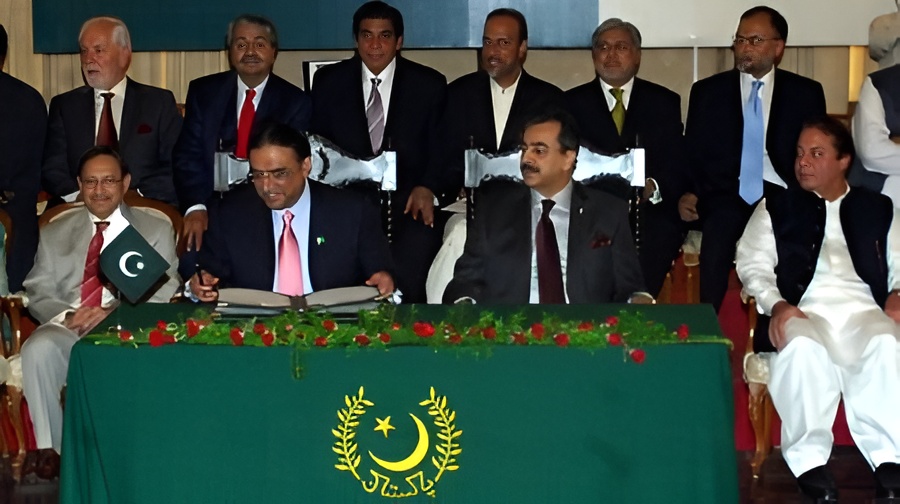
The 18th Constitutional Amendment, enacted on April 19, 2010, stands as a landmark reform in Pakistan’s constitutional history, fundamentally reshaping the balance of power between the federal government and provinces. Passed unanimously by Parliament under the Pakistan People’s Party (PPP) government led by President Asif Ali Zardari, it aimed to restore the parliamentary character of the 1973 Constitution, enhance provincial autonomy, and undo distortions introduced by military regimes. Over 15 years later, in 2025, its effects continue to influence Pakistan’s federal structure, fiscal relations, and democratic institutions amid ongoing debates over recent amendments like the 26th and 27th. This detailed analysis explores its background, key provisions, strengths, impacts, criticisms, implementation challenges, and enduring legacy.
Background: From Military Distortions to Democratic Restoration
The 18th Amendment emerged from a consensus-driven process initiated by the Charter of Democracy (2006), signed between PPP’s Benazir Bhutto and PML-N’s Nawaz Sharif. It addressed long-standing grievances over centralization of power, particularly under military dictators like General Zia-ul-Haq (8th Amendment, 1985) and General Pervez Musharraf (17th Amendment, 2003), which had empowered the presidency to dissolve assemblies and extended military influence. The amendment was drafted by a 27-member Parliamentary Committee on Constitutional Reforms, reflecting broad political support across parties and provinces. It received presidential assent and was promulgated the next day, consisting of 102 changes that amended, substituted, added, or deleted various provisions.
The primary goals were to fulfill demands for provincial autonomy, abolish the Concurrent Legislative List (where federal and provincial governments shared powers), and strengthen democratic institutions by limiting executive overreach. This came at a time when Pakistan was transitioning from Musharraf’s rule, with the PPP government seeking to decentralize authority to provinces amid ethnic and regional tensions.
Key Provisions: A Comprehensive Overhaul
The 18th Amendment introduced sweeping changes across multiple areas. Below is a table summarizing the most significant provisions:
| Category | Key Changes | Implications |
|---|---|---|
| Provincial Autonomy | Abolition of the Concurrent Legislative List (47 subjects deleted from the Fourth Schedule); residuary powers vested solely in provinces for non-federal matters. | Provinces gained exclusive legislative authority over areas like education, health, environment, and labor, ending federal overlaps. |
| Federal Legislative List | Subjects like electricity and professional standards moved to Part-II (under Council of Common Interests oversight); new additions include regulatory authorities and higher education standards. | Promoted shared federal-provincial management for inter-provincial coordination. |
| Natural Resources | Joint and equal ownership of mineral oil and natural gas between provinces and the federation (Article 172(3)). | Enhanced provincial rights over resources, addressing grievances in resource-rich areas like Balochistan. |
| Council of Common Interests (CCI) | Mandatory meetings every 90 days; empowered to formulate policies for Part-II subjects. | Strengthened intergovernmental coordination. |
| Judicial and Executive Reforms | Removal of presidential power to dissolve assemblies (deletion of Article 58-2(b)); changes to judicial appointments (later refined in 19th Amendment). | Restored parliamentary supremacy and reduced military intervention risks. |
| Fiscal Powers | Expanded provincial taxing authority (e.g., sales tax on services); provinces allowed to borrow domestically and internationally with NEC limits. | Aimed at financial empowerment but tied to federal oversight. |
| Other Changes | Renaming NWFP to Khyber Pakhtunkhwa; devolution of 17 federal ministries; lifetime disqualification for corrupt officials. | Addressed identity issues and streamlined federal bureaucracy. |
These provisions marked one of the largest deconcentrations of power since 1973, devolving responsibilities for planning, industry, agriculture, and social services to provinces.
Strengths: Bolstering Democracy, Institutions, and Federation
The amendment significantly strengthened Pakistan’s democratic framework by reasserting parliamentary sovereignty and reducing the presidency’s arbitrary powers, making military takeovers less feasible through constitutional means. It enhanced institutional integrity by clarifying roles, limiting federal overreach, and promoting accountability—decision-making moved closer to citizens, potentially improving responsiveness in diverse provinces.
For federation, it addressed center-province imbalances by granting autonomy, which helped mitigate ethnic conflicts and secessionist threats in a “holding together” federal model. The revival of the CCI and NEC made them more inclusive, fostering harmony and trust. Overall, it was evaluated as a progressive step toward true federalism, fulfilling long-standing provincial demands and decentralizing power without compromising national unity.
Impacts: Positive Transformations and Unintended Consequences
Positive Impacts:
- Federalism and Decentralization: Shifted to a “coordinate authority” dual federalism model, empowering provinces in service delivery (e.g., education, health). By FY 2015, provincial expenditure share rose from 25% to 55%, with federal dropping to 45%.
- Fiscal Relations: Expanded provincial revenues through new taxes (potential 0.5%-1% GDP from services tax); 7th NFC Award (2009) introduced horizontal equalization based on poverty and tax effort.
- Political Stability: Reduced incentives for military interventions; addressed regional disparities, enhancing national cohesion.
Negative Impacts:
- Fragmentation Risks: Provincial ownership of resources could spark inter-provincial conflicts (e.g., water, gas distribution); potential for “beggar-thy-neighbor” policies and barriers to internal trade/mobility.
- Fiscal Strain: Provinces rely on federal transfers (“manna from heaven”), lacking accountability; federal deficits increased by 3% initially.
- Service Delivery: Devolution without local government empowerment led to provincial centralization, inefficiencies, and elite capture.
Criticisms: Financial Disparities and Missed Opportunities
Critics argue the amendment strained provincial finances, creating disparities as smaller provinces lack capacity to manage devolved functions. It missed institutionalizing constraints on trade barriers or ensuring minimum national service standards, risking market fragmentation. Judicial appointment changes sparked controversies, leading to the 19th Amendment. In 2025, amid the 27th Amendment’s judicial overhauls, some view the 18th as a “gold standard” now under threat.
Implementation Challenges: From Devolution to Reality
An Implementation Commission was formed in May 2010 to complete devolution by June 30, 2011. Challenges included employee repositioning (61,231 federal staff transferred), asset/liability divisions, budgetary reallocations, and drafting new provincial laws. Phased winding up of ministries faced hurdles like funding vertical programs and bureaucratic resistance. No retrenchments occurred, but capacity building and financial sustainability remained issues, with provinces assuming expenditures post-2011.
Legacy in 2025: A Benchmark Amid Evolving Politics
In 2025, the 18th Amendment’s legacy endures as the most progressive reform, promoting devolution and democracy. However, recent amendments (26th and 27th) have sparked fears of recentralization, particularly in judicial matters. Recommendations for enhancement include fiscal responsibility laws, tax harmonization, and further local devolution to realize its full potential. As Pakistan grapples with political turmoil, the 18th Amendment remains a testament to consensus-driven change, though its implementation underscores the need for ongoing reforms.