
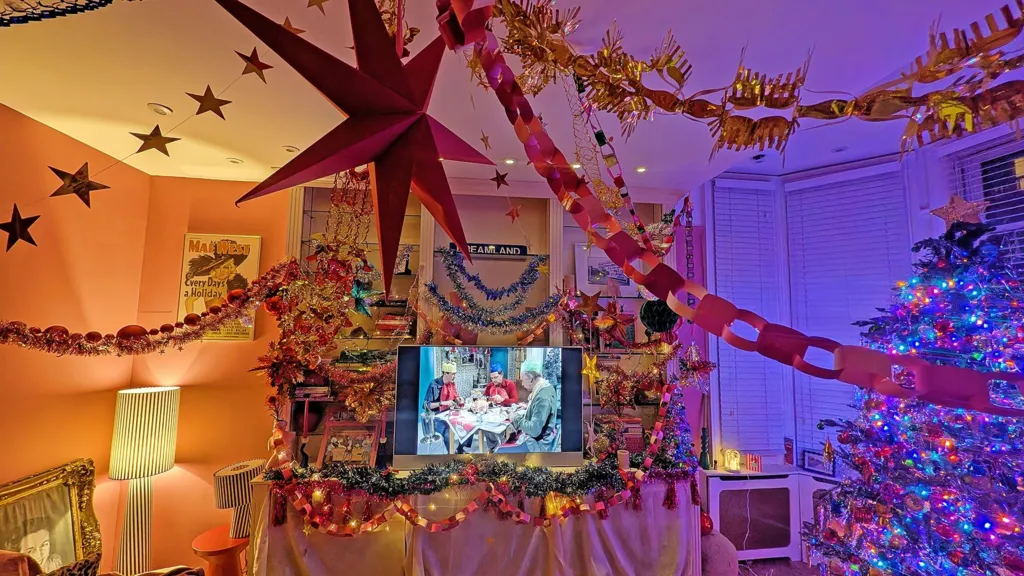
Tinsel-covered trees, foil garlands, colourful fairy lights and bold decorations that once defined festive homes are making a major comeback, as retro Christmas decor emerges as one of the biggest trends of 2025.
Experts say a growing sense of nostalgia is driving people away from minimal, neutral Christmas styles and toward maximalist, playful and mismatched decorations that recreate the festive magic of childhood.
“After years of pared-back, traditional Christmas aesthetics, people are now embracing fun, excess and nostalgia,” said Harry Bradshaw, from events and interiors styling company At Last Events.
🎁 Maximalism Returns to Christmas Homes
Retailers report a sharp rise in demand for decorations inspired by the 1970s, 1980s and 1990s, including colourful bells, oversized baubles, bows, paper chains and flashing lights.
“Maximalism is making a bold return,” said Abi Wilson, head of seasonal and gift buying at Habitat, noting that customers are increasingly drawn to vibrant, retro-inspired designs.
Primark said shoppers from younger Gen X, millennials and older Gen Z are buying decorations that remind them of Christmases from their childhood. Meanwhile, Marks & Spencer reported strong sales of tinsel rosettes and tree skirts, and John Lewis said sales of retro-style Christmas decor have surged by 180% in 2025.
🌟 Finding Comfort Through Festive Nostalgia
For many, the trend is deeply emotional. Felicity Hayward, 37, from Margate, Kent, rediscovered her love for Christmas after finding vintage foil stars in a charity shop—decorations that reminded her of festive celebrations at her grandparents’ home.
Those 50p decorations sparked a two-month hunt for retro baubles, garlands and paper chains to recreate her childhood Christmases of the 1990s.
“Christmas always revolved around my grandparents,” Felicity said, recalling days filled with homemade snacks, Frank Sinatra music, films and board games. After years of loss and grief, she says her brightly decorated living room now brings her peace.
“Some people might call it tacky, but for me, all those colours bring me calm,” she said.
🕯️ A Desire to Return to Simpler Times
Christmas traditions act as a source of emotional grounding, according to Hannah Bartlett, founder of The Christmas Insider. She explained that decorating homes is often a reflection of what people emotionally need from the festive season.
“With so much uncertainty in the world, people are seeking comfort in traditions that remind them of simpler times,” she said.
Influencer Pandora Maxton, 52, from York, agrees, saying bold decorations “take people back to being kids,” which is why they are enjoying a revival.
🎶 Vintage-Themed Celebrations Gain Popularity
Others are taking nostalgia even further. Holly Langley, 34, from Reading, hosted an 1980s-themed Christmas, complete with retro tableware, foil decorations, vintage music and themed food.
“It was different, quirky and fun,” Holly said, adding that breaking from routine helped make the celebration feel special.
🛍️ Why Retro Decorations Were So Bold
According to vintage decor collector Lucy Scott, bright and bold Christmas decorations gained popularity in 1970s Britain as symbols of hope during times of economic hardship and social unrest. Limited choices also meant brightly coloured tinsel and foil decorations dominated the market.
While options expanded in the 1980s and beyond, Lucy notes that the durability of old decorations is part of their appeal today.
“These tinsels are 20 to 30 years old and still intact,” Felicity added. “This isn’t just a trend for me—this is my Christmas forever.”