
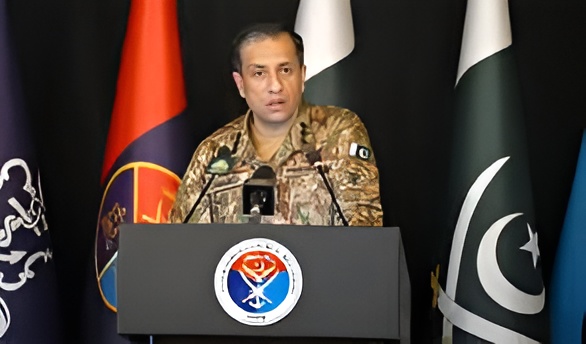
Rawalpindi, November 29, 2025 – In a stark warning, Director General of Inter-Services Public Relations (DG ISPR) Lieutenant General Ahmed Sharif Chaudhry has declared that the Afghan Taliban regime now represents a major threat not only to Pakistan but to the entire region and the world. Speaking to senior journalists this week, he pointed to the abandonment of $7.2 billion worth of advanced American military equipment during the 2021 US withdrawal from Afghanistan, which has ended up in the hands of terrorists.
Lt Gen Chaudhry’s briefing highlighted Pakistan’s relentless fight against terrorism, exposing how the Afghan regime is actively facilitating cross-border attacks and sheltering militant groups. This comes amid rising tensions along the Pak-Afghan border and ongoing counter-terrorism efforts that have neutralised thousands of threats this year.
Pakistan’s Massive Counter-Terrorism Success: Key Statistics from DG ISPR
Pakistan’s security forces have delivered impressive results in the battle against terrorism. According to the DG ISPR:
- Since November 4, 2025: 4,910 intelligence-based operations (IBOs) conducted, eliminating 206 terrorists.
- Throughout 2025: 67,023 IBOs nationwide, resulting in 1,873 terrorists killed, including 136 Afghan nationals.
- Major focus areas: 12,857 operations in Khyber Pakhtunkhwa (KP) and 53,309 in Balochistan.
These operations average an incredible 233 IBOs per day in recent weeks, showcasing the armed forces’ unwavering commitment to protecting citizens.
Pak-Afghan Border Challenges: Difficult Terrain and Afghan Facilitation
Managing the 2,600 km Pak-Afghan border is no easy task. The DG ISPR explained that the 1,229 km stretch in KP alone features rugged mountainous terrain with just 20 official crossing points. Pakistani posts are often 20-25 km apart, and full fencing requires constant surveillance, drones, and massive resources.
Worryingly, Lt Gen Chaudhry revealed that Afghan forces frequently open unprovoked fire on Pakistani checkposts to create distractions, allowing terrorists to slip through gaps. “Borders are mutually guarded, but when one side initiates fire to help infiltrators, it becomes a serious issue,” he said.
Political-Terror-Crime Nexus Fuelling Attacks
A dangerous “political-terror-crime nexus” is thriving in border regions, enabled by the Fitna al-Khawarij (TTP militants). This network uses millions of non-custom-paid vehicles for suicide bombings and smuggling.
The DG ISPR challenged provincial authorities: “If these illegal vehicles are roaming freely in your area, who is responsible for stopping them?” He praised the crackdown on Iranian diesel smuggling, which has slashed daily volumes from 20.5 million litres to just 2.7 million litres. Previously, these funds supported groups like the Balochistan Liberation Army (BLA) and Balochistan Youth Council (BYC).
Pakistan’s Firm Stance on Doha Agreement and Verifiable Mechanism
Pakistan remains committed to the Doha Agreement but demands the Afghan Taliban stop harbouring terrorists. Leadership and infrastructure of groups like al-Qaeda and Daesh (ISIS) are based in Afghanistan, receiving arms and funding to target Pakistan.
The DG ISPR proposed a verifiable mechanism to monitor and stop these activities, adding that Pakistan has no objection if a neutral third party oversees it. He dismissed Afghan claims that militants are Pakistani “guests” who migrated, urging them to hand over any Pakistani nationals for legal action under Pakistani law.
Why the Afghan Regime is a Global Threat
Lt Gen Chaudhry stressed that the Taliban regime is sheltering “non-state actors” endangering multiple countries. Since taking power in 2021, they have failed to form an inclusive government, excluding women (50% of the population) and many ethnic groups.
“Pakistan has no issue with the Afghan people – our problem is with the Taliban regime,” he clarified. The abandoned US weapons have armed these groups, amplifying the danger worldwide.
Bloodshed and Trade Cannot Coexist: Security Over Commerce
Concluding his remarks, the DG ISPR stated: “Bloodshed and trade cannot go together.” Pakistan has restricted trade with Afghanistan to prioritise the safety of its citizens. Lives and property come first, even if it impacts economic ties.
He also noted the repatriation of Afghan refugees: 971,604 in 2025 (including 239,574 in November) and 366,704 in 2024, as part of efforts to enhance security.
Table of contents
- Pakistan’s Massive Counter-Terrorism Success: Key Statistics from DG ISPR
- Pak-Afghan Border Challenges: Difficult Terrain and Afghan Facilitation
- Political-Terror-Crime Nexus Fuelling Attacks
- Pakistan’s Firm Stance on Doha Agreement and Verifiable Mechanism
- Why the Afghan Regime is a Global Threat
- Bloodshed and Trade Cannot Coexist: Security Over Commerce
- What This Means for Pakistan-Afghanistan Relations in 2025
What This Means for Pakistan-Afghanistan Relations in 2025
This briefing underscores escalating tensions and Pakistan’s resolve to combat terrorism from Afghan soil. With undeniable evidence shared repeatedly, Islamabad calls for immediate action from Kabul. As cross-border attacks continue, experts warn of potential further restrictions unless the Taliban fulfils its commitments.
Stay updated with Sindh Ajrak News for the latest on Pakistan-Afghanistan border tensions, DG ISPR updates, and counter-terrorism operations.
Tags: DG ISPR warning Afghan regime, Pakistan terrorism 2025, Pak-Afghan border threat, abandoned US weapons Afghanistan, Fitna al-Khawarij nexus, intelligence-based operations Pakistan